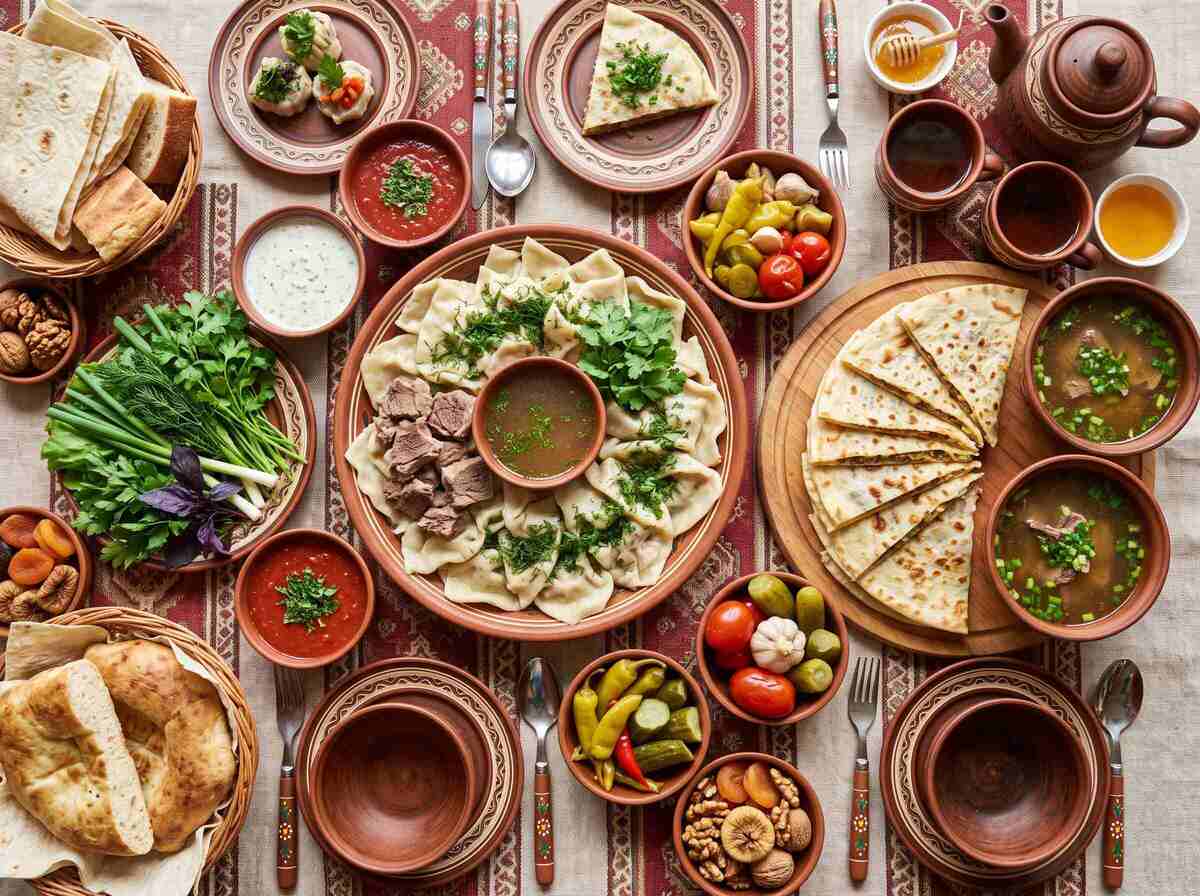
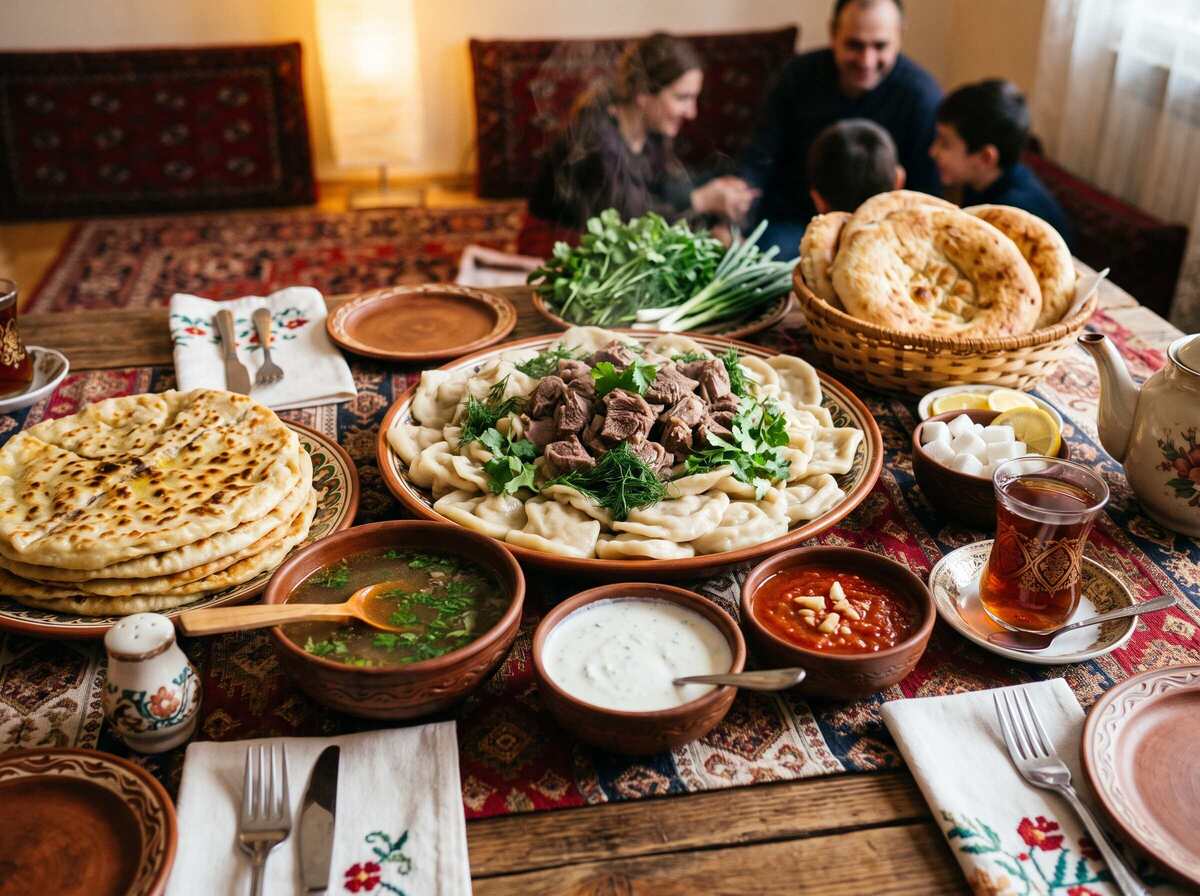
Khinkal, chudu and sauces are served on the table at the same time. Image created using AI (Nano Banana 2 Pro, Gemini)
In Dagestan, the table is set entirely at once: a wide platter with chunks of boiled dough, boiled meat next to it, bowls of strong broth, two bowls of sauces, and a stack of thin flatbreads. About six guests gather at such a table, and each person's portion is calculated so that no second helping is needed. Khinkal, chudu, kurze, urbech—Dagestani cuisine relies on its own dishes, the names of which are far less familiar outside the republic than their Georgian counterparts.
The main points about Dagestan cuisine
- Khinkal and Georgian khinkali differ in dough, shape and serving method.
- The culinary traditions of more than 30 nationalities converge in the republic.
- Urbech is a paste made from ground seeds and eaten with honey and butter.
- Lamb and fat tail are found in most recipes.
- The most interesting food is found in guest houses and at family feasts.
What is Dagestani cuisine and what makes it unique?
The Republic of Dagestan has no unified set of recipes: the cuisines of the peoples living in different valleys developed separately. Dagestani cuisine represents the entire Caucasus in miniature: Avars, Dargins, Kumyks, Lezgins, Laks, and Tabasarans all have their own unique cooking styles, and the same dish can look different in neighboring valleys. In the mountains, lamb, corn flour, and fermented milk products are common. On the Caspian coast, fish, rice, and vegetables are added, reflecting the proximity of trade routes.
History and Key Factors
The menu was based on what the slopes of the Greater Caucasus Range and the narrow strip of terraced fields provided. Winters in the mountains are long, and firewood was conserved, so the food was hearty and calorie-dense: rich broth, dough, and meat. Cooking was done in a single cauldron for the whole family, hence the custom of setting out a large, communal dish. Four factors shaped Dagestani tastes:
- cattle breeding on mountain pastures - hence the lamb and fat tail fat at the base of the hot dish;
- terraced farming - corn and wheat flour, from which they bake churek and roll dumplings;
- Derbent as an ancient trading hub – through it came cumin, coriander and rice;
- Islam and the rules of halal - pork is excluded from the diet, the meat part is based on lamb and beef.
Main products
The food selection in Dagestan is short: five or six items make up the entire feast. Lamb and fat from the tail are used in hot dishes and baked goods, and the fat is rendered and stored for months. Kefir and ayran are used to leaven dough and make sauces. Flatbreads, dumplings, and khinkal are made from corn and wheat flour. Wild herbs (nettles, wild garlic, wild onions) are gathered in April and May, while the leaves are soft, and added to fillings. Garlic is added to sauces for almost every meat dish: it is pounded with salt and diluted with broth or sour cream.
A separate item is urbech. Pasta grind Made from flaxseed, hemp, apricot kernels, sunflower seeds, pumpkin seeds, and nuts, the ingredients are ground on stone millstones without heating. The finished mixture is mixed with honey and butter and spread on bread.
The Main Dishes of Dagestani Cuisine: What You Must Try
The order of the feast is always the same: first, a hot dish with broth is served, then flatbreads and kurze, and for dessert, sweet pastries. The dishes are sampled in the same order.
Khinkal is the main symbol of Dagestani cuisine.
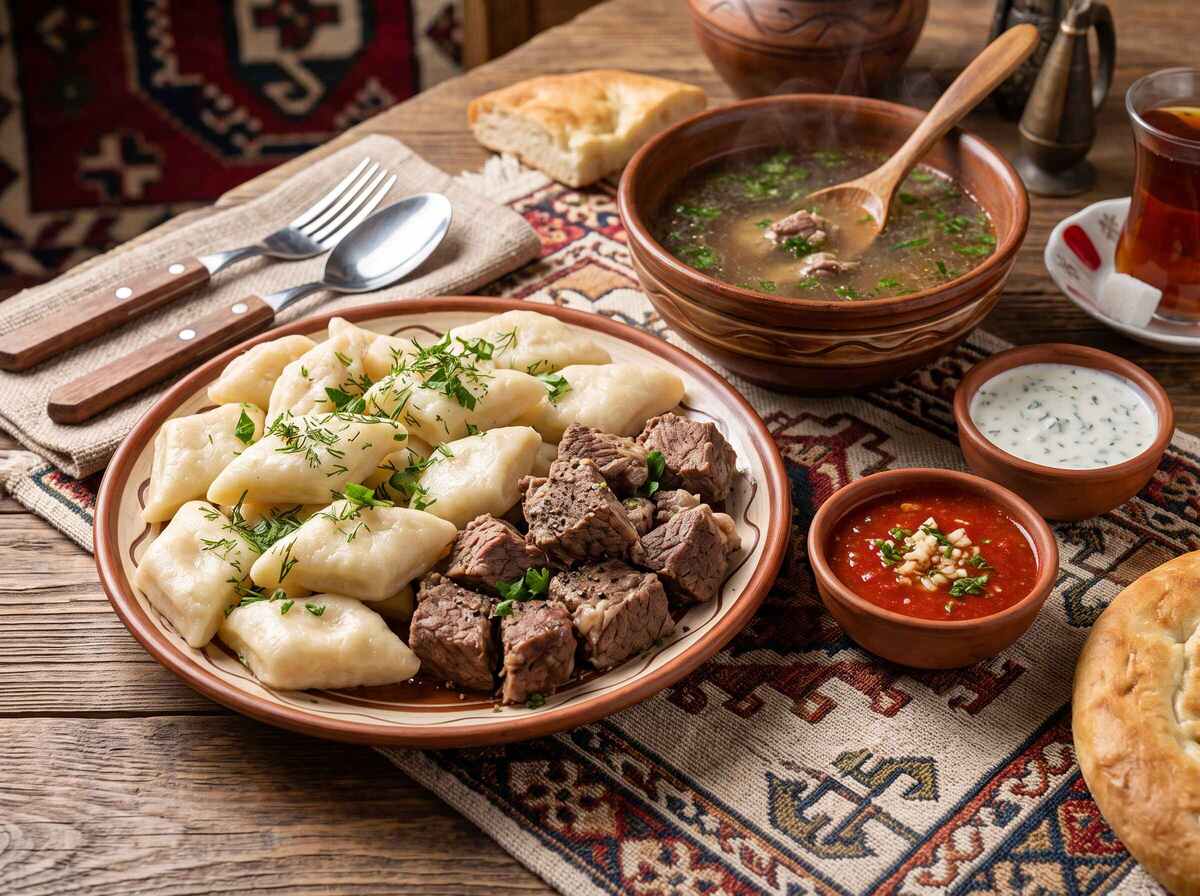
Avar khinkali is served with broth and two sauces. Image generated using AI (Nano Banana 2 Pro, Gemini)
The name can be confusing for visitors: Georgian khinkali are small pouches filled with filling and broth, eaten with your hands. In Dagestan, khinkali are made from three separate parts on a single plate: pieces of boiled dough, boiled meat, and broth in a bowl. The dough here is hollow; the sauces add flavor.
The form of the test varies from nation to nation. Avar variant They're mixed with kefir and baking soda and cut into diamonds—after cooking, they rise and become fluffy. Kumyk khinkal is rolled out thinly from unleavened dough. Lak khinkal is rolled into shells. Dargin khinkal is made flaky: the dough is rolled into a roll, generously buttered and sprinkled with nut grass (a local spice). Portions are generous everywhere: a plate of khinkal in Dagestan is served with the expectation that one serving is enough to fill one's stomach.
The order of serving has been maintained for centuries and functions like a ritual:
- The dough is placed on a common dish in a mound.
- The meat is served separately, in large pieces.
- The broth is poured into bowls and drunk throughout the meal.
- Two sauces are placed next to each other: tomato with garlic and sour cream with garlic.
- Each piece of dough is dipped in sauce and eaten with meat.
INTERESTING FACT. Dough left in boiling water for too long will settle and become rubbery—this can't be fixed. Avar khinkal is removed with a slotted spoon immediately after it floats to the surface and pierced with a fork to release the steam.
Miracle and Curse
The chudu is rolled out thinly, the filling is placed on half of the circle, covered with the other half, and the edge is pinched shut. Fry in a dry frying pan without oil for a couple of minutes on each side. The finished flatbread is immediately brushed with butter—this softens the dough and gives it a glossy sheen. Almost any filling can be used:
- minced meat with onions;
- cottage cheese with herbs;
- potatoes with fried onions;
- nettle or wild garlic in early spring;
- pumpkin with sugar and cinnamon;
- cheese with egg.
Kurze is made with a braided fold - a tight seam runs along the edge, and by this the dish is unmistakably recognized. The origin of the name is not precisely established.Sources cite a Pranakh root, a loanword from Kumyk, and a connection with the word "gyurza." Kurze are closest to Russian pelmeni in filling, but their shape makes them similar to their Georgian counterparts. Pelmeni making is taught from childhood, and a smooth seam is considered a sign of a good housewife. In Dagestan, kurze is frozen for future use: pre-made batches are placed in the freezer and cooked as needed.
How kurze differs from similar dishes:
| Sign | Kurze | Russian dumplings | Khinkali |
|---|---|---|---|
| Dough | Fresh, thinly rolled | Fresh, dense | Steep, thick at the base |
| Filling | Minced lamb, egg with onion, cottage cheese | Pork with beef | Minced meat with broth |
| Form | Pinch the edge with a braid | Round pinch, ears | Bag with a tail |
| Innings | With sour cream and garlic | With sour cream or vinegar | Hands by the ponytail |
Meat dishes: shurpa, dried meat and shashlik
Shurpa is cooked from bone-in lamb, slowly and slowly. The Uzbek version is seasoned with vegetables and served thick, while the local version remains clear and robust: the bowl contains broth, a piece of meat, and a minimum of herbs. Zhizhig-galnash is another traditional boiled meat dish: it is served with corn dumplings and a garlic sauce made from broth and bay leaf. It is an everyday dish, prepared more often than shurpa in mountain villages.
The republic's specialty is dried meat and homemade sausage. The meat is dried in the mountain sun and wind to preserve it for the winter, giving it a concentrated, incomparable flavor. It is often boiled and served with khinkal.
Shashlik is marinated sparingly: salt, onion, and sometimes black pepper. Young lamb is considered self-sufficient; spices only hinder it.
Offal is used entirely—the liver, lungs, and tripe are used to make sausages and stuffings. Wastefulness didn't take hold in the mountains: livestock was counted, and only inedible parts were wasted. The same principle explains the thick broths: the bones are boiled to the last, and the rendered fat is poured into a jar and later used for dough. In Dagestan, meat is bought chilled from acquaintances or at the market in the morning: frozen meat is not used for shashlik and khinkali.
ADVICE. Portions in Dagestan are sized per person after a day of work in the mountains. One khinkali is enough for two, so for the first meal, it's wise to order one main course and a few chudus to share. A portion for each person usually goes uneaten.
Baked goods and desserts: churek, halva, urbech
Churek is baked from corn or wheat flour. The flatbread is pressed against the side of the tandoor and removed after a few minutes. Corn churek is dense and crumbly, while wheat churek is softer and retains its freshness longer. Dagestani halva is cooked with flour, butter, and honey directly in the cauldron, kneaded until thick, cut into pieces, and served with tea. It has a nutty flavor and moderate sweetness. For Navruz, a separate and plentiful batch is baked: the spring equinox festival is celebrated with a mandatory feast, and the baked goods are shared with neighbors.
Urbech is served at the table for breakfast or tea. The paste is mixed with honey and butter. Mix until smooth and spread on fresh churek. Flaxseed urbech is bitter, apricot urbech has a marzipan-like flavor, and hemp urbech is the thickest. The spoon is heavy, and the paste stretches like a thread behind it—this thickness distinguishes urbech from its confectionery counterparts.
ADVICE. The label of authentic urbech lists one ingredient: seeds or pits. Sugar, vegetable oil, and dry milk in the ingredients indicate it's a confectionery paste. At the market, urbech is sold loose, and the sellers themselves encourage you to try it before buying.
Dagestani cuisine today and where to try it
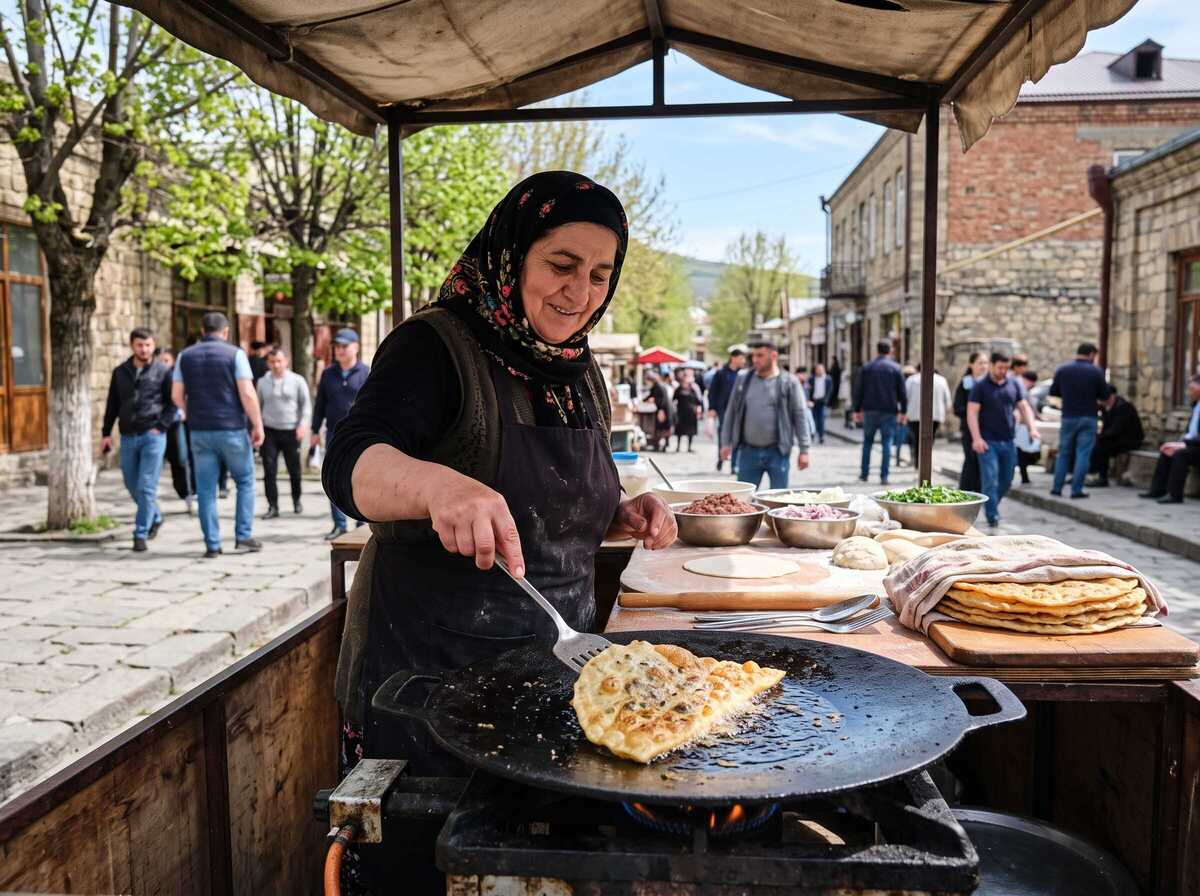
Chudu is fried in front of the guest and served hot. Image created using AI (Nano Banana 2 Pro, Gemini)
In recent years, the republic's national dishes have spread far beyond its borders. Dozens of Moscow establishments serve khinkal and chudu, from family-run cafes to food halls. the demand for them has grown noticeablyChudu has become a popular street food staple: the flatbread is fried in front of the guest and served wrapped in paper. Interest in Dagestani cuisine has been fueled by social media, where videos of kurze being made and khinkali being sliced are garnering millions of views.
In the guesthouses of Gunib, Chokh, and Khunzakh, a single cauldron is set up for both the family and the visitors: khinkali are cooked for lunch, and chudu are fried as guests sit down at the table. Menus aren't printed here—they're simply asked what to cook for the evening. People come for the homemade version: gastronomic tourism in Dagestan has long since become a distinct industry, and the republic's cuisine is part of the itinerary just like the mountains. It's easier to get a seat at such a table with people already known in these houses: individual tour of Dagestan From GO&DO, overnight stays in the mountains are scheduled according to specific villages, and dinners are prepared by the hosts.
You can try that same taste without waiting for your vacation. Service "Country of Mountains" For over ten years, she's been preparing and delivering halal mountain food throughout Moscow: Avar khinkal with airy crumpets, Dargin steamed nut-herb rolls, Kumyk and Lak varieties, thin chudu with cottage cheese, pumpkin, and herbs, and hand-made kurze. Everything arrives hot, with a rich broth and two garlic sauces, just as khinkal should be served.
Frequently Asked Questions
How is Dagestani khinkali different from Georgian khinkali?
These are different dishes with similar names. Khinkali are made into a pouch with a meat filling and broth inside, and eaten with your hands. This isn't the way it's prepared in Dagestan. Khinkali are served in three parts on a single plate: the empty boiled dough, the boiled meat, and the broth in a bowl, accompanied by garlic sauces.
What are Dagestani dumplings called?
Kurze. Its shape is recognizable by its braided folds. The filling can be meat, cottage cheese, or egg and green onions. It's served with sour cream and garlic. A serving is filling, so kurze is often eaten as a main course.
What is the main dish of Dagestani cuisine?
Khinkal. It's prepared in all regions of Dagestan, and each nation has its own dough shape: Avar diamond-shaped pastry, Kumyk thin sheets, Lak shells, and Dargin stuffed rolls. Khinkal is a popular introduction to the local cuisine, and it's also the most common dish on menus.
What is urbech and how is it eaten?
A paste made from seeds or pits ground in a stone mill without heating. Classic varieties include flaxseed, apricot, and hemp. It's eaten for breakfast: mixed with honey and butter and spread on bread or churek. Store in the refrigerator and stir before serving.
Is Dagestani cuisine halal?
In terms of composition, traditional dishes comply with halal principles: pork is not included in the recipes, and the meat portions are based on lamb and beef. The halal status of a particular dish depends on the origin of the meat and the method of slaughter. Many establishments serving this cuisine operate as halal and specifically state this.
Sources
- Urbech // Wikipedia - the free encyclopedia. ru.wikipedia.org
- Magai Yu. Avar khinkal // Recipes. Lifehacker. lifehacker.ru
- Kurze // Wikipedia, the free encyclopedia. ru.wikipedia.org
- Chaikova E. Dagestani Urbech: What It Is, How, and What to Eat It With // Culture and Customs. ENJOY-Caucasus. – November 20, 2024. enjoy-kavkaz.ru
- Demand for Dagestani cuisine has grown in Moscow // VFokuse. vfokuse.mail.ru